Two Classrooms, Two Realities: What I Noticed Between the UK and Pakistan’s Education System
I’ve asked myself this question more than once: what is education actually meant to do?
I care deeply about education because I’ve come to believe that a society cannot truly change without it. The right kind of education doesn’t just teach individuals; it shapes communities, mindset and opportunities. It has the power to influence how people think, what they believe is possible and ultimately the direction their lives take.
Through my own experiences both in the UK and Pakistan, I’ve started to see how differently education can be delivered and experienced
From a young age, I genuinely loved learning.
Not because of grades or exams but because of the feeling that came with it, the moment something finally made sense. That shift from confusion to clarity felt like unlocking something. It made the world feel bigger and more interesting
I didn’t realise it at the time, but that feeling stayed with me.
I also remember the teachers who made that possible. They weren’t necessarily formally qualified or teaching in traditional schools. Some of them taught at weekend institutes, in simple settings but they had a way of making learning feel meaningful.
They encouraged questions. They didn’t rush understanding. They made me think in ways I hadn’t before.
Looking back, I realise they didn’t just teach content they opened my mind.
For a long time, I took that for granted.
It wasn’t until later—when I faced challenges and started seeing how differently others experience education—that I began to understand its real value.
Education isn’t just about what you know.
It shapes your confidence.
It influences your opportunities.
It affects how you see yourself—and your future.
And not everyone gets access to that in the same way.
My love for learning naturally shaped the path I chose.
I didn’t see learning as something that ended with school or degrees. Instead, it became part of how I approached life—whether I was learning coding, exploring new skills, or pushing myself into unfamiliar spaces. For me, learning became a form of self-growth.
That’s what eventually led me to teaching.
It was one of the few paths where I felt I could continue learning while helping others do the same.
I studied Maths, Physics, and Engineering—but deep down, I always knew teaching was where I felt most aligned. It just didn’t always feel like the most “credible” path at the time.
During university, I formally started tutoring with a UK-based online academy. What started as something small quickly grew into something much bigger.
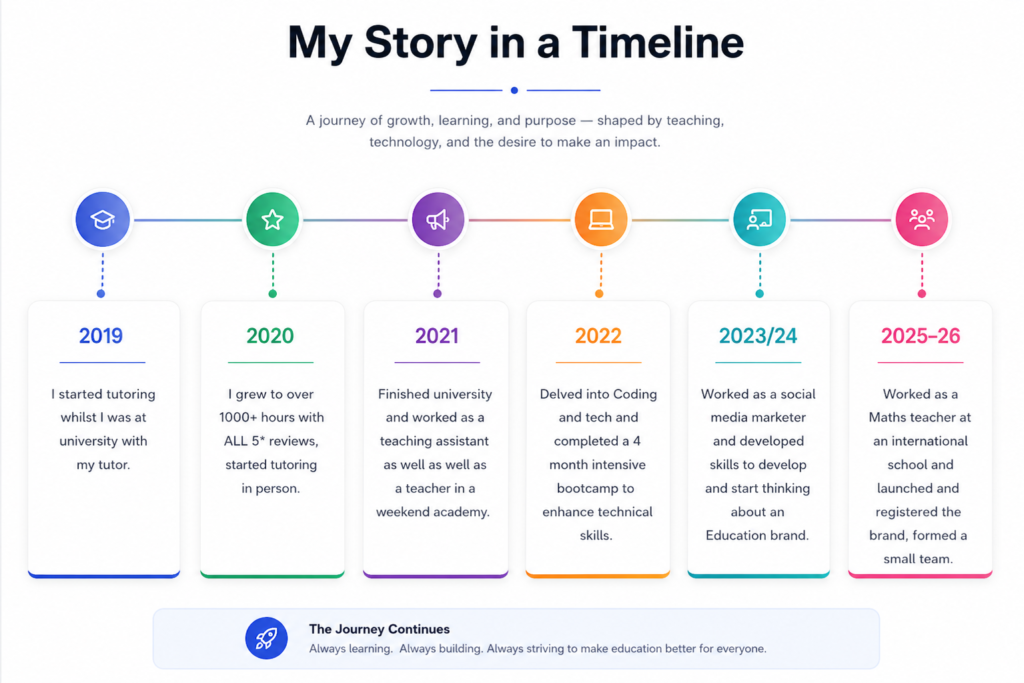
Eventually, I started building my own platform—Educate Cloud—as a way to bring together everything I was learning about education into one space.
But it wasn’t just teaching that shaped my perspective. It was where I was teaching.
Completing my education in the UK—from primary school through to university—gave me one understanding of education.
Spending time in Pakistani classrooms and speaking to students navigating a completely different system—gave me another.
I didn’t spend years in either system as a teacher.
But I didn’t need to.
The differences were clear almost immediately.
And that’s where the question began to take on a new meaning: What is education actually meant to do—when the experience of it looks so different depending on where you are?